Toward the end of the month, April 2026 saw Central Asia asserting itself as both a diplomatic heavyweight and an economic high-performer. At the Antalya Diplomacy Forum, President Tokayev pushed for a fundamental restructuring of the UN Security Council to empower middle powers, while simultaneously strengthening "Great Steppe" ties during a state visit by the Mongolian President, which included discussions on a direct trans-Altai highway. Economically, Uzbekistan continues to set a blistering pace with 8.7% GDP growth in Q1, supported by a 54% surge in tax revenues and a deepening industrial partnership with Azerbaijan. In the energy sector, the discovery of a new productive layer at Kazakhstan’s Kashagan field has revitalized long-term export projections, even as the government contemplates expanding its nuclear ambitions to four units to meet surging demand. The region is also accelerating its "Twin Transition"; Kazakhstan officially launched the Astana AI Hub to spearhead regional digital innovation, while Uzbekistan scaled its agrivoltaics and reforestation efforts to combat desertification and modernize its agricultural energy consumption.
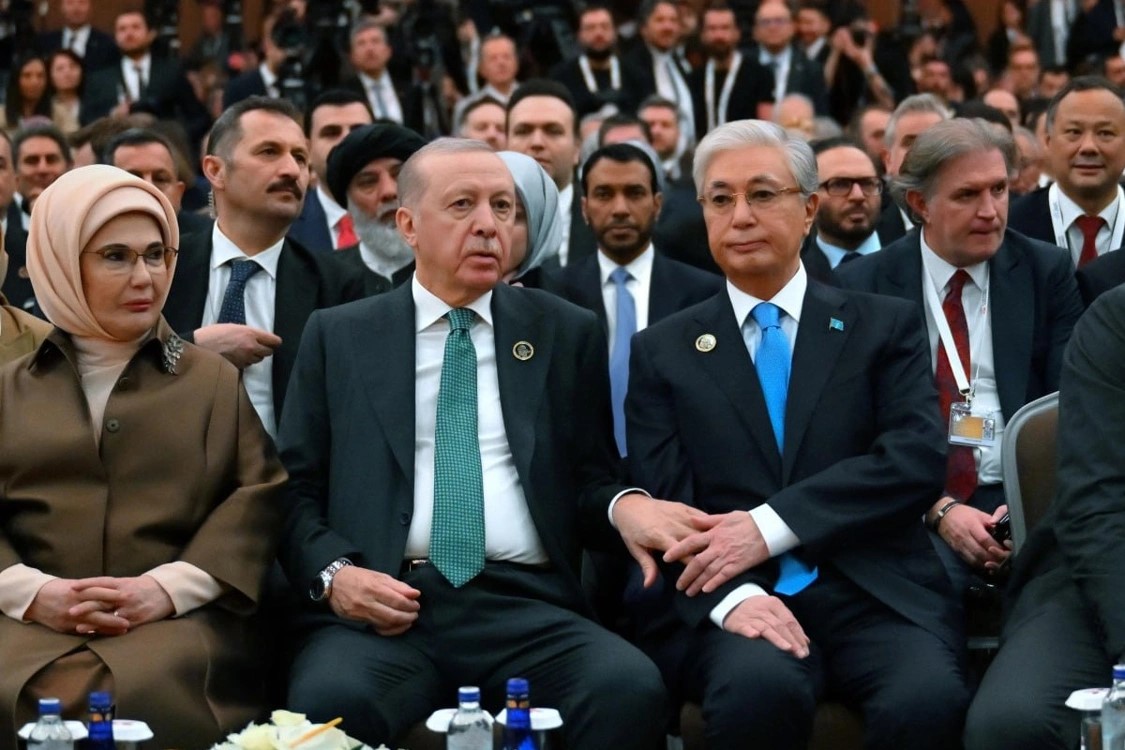
President Tokayev attends opening ceremony of Antalya Diplomacy Forum. Source: Kaz Inform
Diplomatic Events
President Kassym-Jomart Tokayev made a significant diplomatic statement at the Antalya Diplomacy Forum in Turkey, where he called for a "radical reform" of the United Nations Security Council. Tokayev argued that the current global governance structure is failing to prevent conflicts and insisted that "middle powers" and developing nations must have a more decisive voice in international security decisions to prevent a total collapse of the multilateral system (Tengri News, Orda).
Elsewhere and in a major move to strengthen "trans-steppic" ties, the President of Mongolia arrived in Kazakhstan for a landmark state visit. The summit focused on historical and cultural kinship, but resulted in a concrete strategic proposal: the development of a direct highway between Kazakhstan and Mongolia. Currently, transit between the two countries requires traversing multiple borders; a direct route would significantly reduce logistics costs and boost trade across the Altai region (Orda).
Beyond the region, Kazakhstan reinforced its "multi-vector" approach through high-level consultations in Washington, D.C. The talks focused on bilateral economic cooperation, regional security, and the ongoing implementation of the C5+1 framework, emphasizing the U.S. commitment to Kazakhstan’s sovereignty and economic diversification (Orda).
In the meantime, the Uzbekistan-Azerbaijan axis reached a new level of maturity. Following a series of ministerial meetings, the two nations signed a roadmap to advance industrial and trade cooperation, focusing on joint ventures in automotive manufacturing, textiles, and energy. This partnership is increasingly seen as a stabilizing "bridge" between Central Asia and the South Caucasus (Daryo, Interfax).
Macroeconomics
The first quarter of 2026 has seen Uzbekistan’s economy achieve a significant expansion of 8.7%, a growth spurt driven by a sharp rise in both domestic and foreign investment. This performance is largely attributed to ongoing market reforms and the government’s aggressive strategy to integrate the national economy into global markets (Daryo). This macroeconomic strength is further evidenced by a 54% surge in tax revenues recorded in March 2026. According to the Center for Economic Research and Reforms (CERR), this increase reflects improved tax administration and a broadening of the formal economic base (Daryo).
However, this rapid growth is accompanied by a notable rise in consumer and institutional liabilities. Reports indicate that mortgage lending in Uzbekistan has reached $1.7 billion following a steady increase in debt throughout 2025. While this expansion in the credit market supports the burgeoning construction and housing sectors, analysts are closely monitoring the rising debt levels to ensure long-term financial stability as the country’s middle class continues to expand (Daryo).
Connectivity and Trade
The region is undergoing a significant expansion of its transport and commercial infrastructure to facilitate both domestic mobility and international trade. In Kazakhstan, the civil aviation sector is set for a major boost with the announcement of launch dates for two new airports in the Katon-Karagay and Ulken Naryn districts of the East Kazakhstan region. These facilities are designed to enhance regional tourism and connectivity, with flights planned to major hubs like Astana and Almaty starting in 2026 (Tengri News).
In Uzbekistan, the focus is on modernizing both retail and heavy transport. In Tashkent, a new $25 million pavilion and construction materials complex has officially opened. This large-scale development is aimed at professionalizing the construction trade and modernizing the retail experience for industrial goods within the capital (Daryo). Simultaneously, the Fergana Valley has seen a major leap in connectivity with the launch of a 324 km electric railway connecting the cities of Namangan, Andijan, and Margilan. This new line, which boasts an annual capacity of 600,000 passengers, represents a significant shift toward sustainable, high-capacity transport in one of the most densely populated regions of Central Asia (Daryo).
Energy:
The week was highlighted by a major breakthrough in Kazakhstan's primary energy sector with a promising new oil discovery at the Kashagan field. Operators announced the identification of a new productive layer that could significantly bolster the country's long-term export capacity, reinforcing the Caspian shelf's role as a cornerstone of global energy security (Orda). To support broader infrastructure and sustainable development, international development banks have committed to investing billions of dollars in Kazakhstan, with funds earmarked for modernizing the energy grid and supporting large-scale transition projects (Orda).
Domestically, the government is accelerating plans to address the country's heating and electricity crisis. Authorities have announced that aging CHP (Combined Heat and Power) plants in several major cities could be entirely replaced by more efficient, modern installations to prevent recurring winter outages (Tengri News). Furthermore, the discourse around the national energy balance has shifted significantly as officials have begun discussing the possibility of a fourth nuclear power plant project, expanding the previous vision of a three-unit strategy to meet the projected surge in industrial and residential power demand over the next decade (Tengri News).
Green Transition:
The region is increasingly integrating environmental sustainability into both its high-level diplomacy and its practical land-management strategies. At a major summit held at the Expo Center in Astana, President Tokayev welcomed regional leaders to discuss collective climate action (Tengri News), using the platform to outline five key principles for a sustainable future. These principles emphasize the necessity of regional water-energy cooperation, the harmonization of environmental standards, and the shared responsibility of Central Asian states in mitigating the impacts of global warming (Tengri News).
In Uzbekistan, the "Green" agenda has shifted toward large-scale implementation in the agricultural and ecological sectors. The government has significantly scaled its desertification response, reporting that 220,000 hectares of trees and shrubs have been planted to stabilize arid lands and prevent soil erosion (Daryo). Furthermore, following a successful pilot project in the Quva district of the Fergana region, Uzbekistan has announced plans to scale the agrivoltaics model nationwide. This innovative approach—which involves installing solar panels over active farmland—allows for the dual use of land for both crop production and renewable energy generation, optimizing water usage and providing a sustainable energy source for rural communities (Daryo).
Digital Transformation:
Central Asia’s digital landscape is witnessing a dual push toward high-level artificial intelligence development and the foundational expansion of IT human capital. In Kazakhstan, President Tokayev officially inaugurated the Alemai AI Center and launched the Astana AI hub, signaling a strategic national commitment to becoming a regional leader in machine learning and data science. The center is designed to serve as an incubator for local tech talent and a platform for integrating AI solutions into various sectors of the economy, including governance and industry (Tengri News).
Meanwhile, Uzbekistan is focusing on the long-term sustainability of its digital economy through international educational partnerships. KOICA (Korea International Cooperation Agency) has allocated $14 million to support IT education and youth employment initiatives across the country. This funding is earmarked for modernizing vocational training programs and establishing IT centers that provide young Uzbeks with the technical skills required to compete in the global digital market, directly supporting the government's "Digital Uzbekistan – 2030" strategy (Daryo).