
This week was defined by a regional pivot toward institutionalizing strategic alliances and modernizing critical infrastructure. Kazakhstan and Uzbekistan significantly deepened their "eternal friendship" through a high-level summit in Bukhara, setting ambitious trade targets and joint industrial goals. Economically, the region continues to outperform the broader Europe and Central Asia (ECA) zone, with Kyrgyzstan and Uzbekistan identified as global leaders in GDP growth, though inflation remains a persistent headwind. In the energy and defense sectors, Kazakhstan is increasingly asserting its autonomy; while maintaining massive coal reserves, the state is aggressively modernizing its power grid following the exit of Russian contractors and leading the region in per-capita military spending with a sharp focus on UAV technology and Turkic security cooperation.
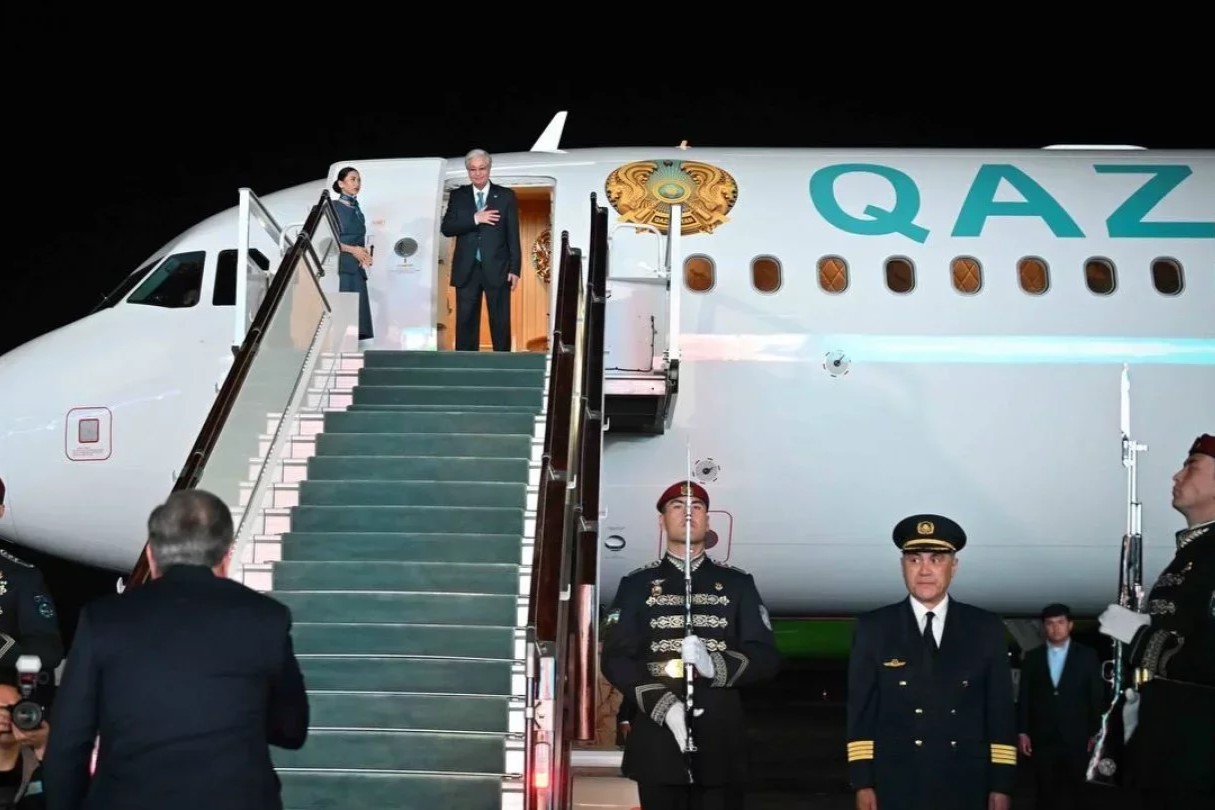
President Kassym-Jomart Tokayev completed his visit to Uzbekistan. Source: Orda
Diplomatic Events
President Kassym-Jomart Tokayev concluded a high-stakes working visit to Uzbekistan, meeting with President Shavkat Mirziyoyev in the historic city of Bukhara to reinforce the "strategic partnership and alliance" between the region’s two largest economies (Daryo). The talks were characterized by a pragmatic focus on moving beyond traditional extractive trade toward higher-value industrial cooperation and cultural integration. A major outcome of the summit was the commitment to accelerate the creation of the "Central Asia" International Center for Industrial Cooperation, a joint project designed to streamline cross-border value chains and bolster regional economic sovereignty (Orda).
Beyond the economic agenda, the two leaders held extensive discussions on environmental security, specifically the joint management of transboundary water resources. Amidst fluctuating regional water levels, Astana and Tashkent agreed to deepen technical cooperation and data-sharing to ensure the sustainable irrigation of the Syr Darya basin (Orda). Following the formal negotiations, the presidents toured the historic architectural monuments of Bukhara, emphasizing that cultural diplomacy remains a cornerstone of the "eternal friendship" between the two nations (Daryo). This visit underscores a growing trend in Central Asian diplomacy where bilateral summits are increasingly used to resolve complex technical issues—such as logistics and water rights—while projecting a unified front to external global actors.
Kazakhstan’s multi-vector diplomacy continued to expand through a series of high-level engagements aimed at strengthening both regional and trans-regional ties. President Tokayev met with the CSTO Secretary General to discuss the organization's evolving role in maintaining regional stability, particularly in light of shifting geopolitical pressures on the bloc's southern borders (CSTO). Elsewhere in Tbilisi, the Foreign Ministers of Kazakhstan and Georgia met to discuss the current state of bilateral relations, emphasizing a mutual commitment to deepening "mutually beneficial cooperation" (Newsline). This diplomatic push in the Caucasus was further highlighted by preparations for President Tokayev’s official visit to Armenia; the Armenian Ambassador to Kazakhstan stated that this upcoming visit is expected to provide a "new impetus" to the strategic partnership between Astana and Yerevan (Newsline).
Simultaneously, Kazakhstan reinforced its presence in East Asia as the country's newly appointed Ambassador to the Republic of Korea presented his credentials in Seoul, signaling a continued focus on high-level engagement with South Korean partners (Newsline). These international efforts were grounded by the landmark meeting in Bukhara, where the Presidents of Kazakhstan and Uzbekistan formally agreed to deepen their "strategic partnership and alliance." This agreement sets a roadmap to increase bilateral trade to $10 billion, accelerates the construction of the "Central Asia" International Center for Industrial Cooperation, and commits both nations to joint ecological efforts, including the "Clean Air" project and the collaborative development of the Kambarata HPP-1 (UzDaily).
Meanwhile, Central Asian capitals responded with collective relief to the announcement of a comprehensive ceasefire in the Middle East, mediated by Pakistan and supported by international actors (Kabar). President Kassym-Jomart Tokayev formally welcomed the truce, praising the diplomatic efforts of Pakistani leadership and noting that a durable peace is vital for the restoration of Eurasian transport corridors that had been disrupted by the recent volatility (Orda). In a parallel statement, the Kyrgyz Republic’s Ministry of Foreign Affairs reiterated that all disputes must be resolved through political and diplomatic means in accordance with the UN Charter, expressing hope that the agreement would serve as a foundation for a long-term political settlement (Kabar). These reactions underscore the region's prioritization of trade route stability and food security, which remain highly sensitive to Middle Eastern shocks.
Macroeconomics
The World Bank’s latest regional update identifies Central Asia as the primary growth engine for the Europe and Central Asia (ECA) region, with Uzbekistan projected to remain among the fastest-growing economies globally through 2026 (Daryo). This outlook is corroborated by the Asian Development Bank (ADB), which forecasts Uzbekistan’s economic growth at 6.7%, driven by robust domestic consumption and significant industrial investments (UzDaily). However, the region faces a bifurcated economic landscape; while growth remains strong, the Kyrgyz Republic is emerging as a regional leader in GDP expansion with a projected growth rate of 8.9% for 2026, though this performance is tempered by concerns over rising inflation and external debt service pressures (AKIpress, Kabar).
In Kazakhstan, fiscal performance has shown significant resilience as the government reported that budget revenues rose by nearly 17% year-on-year, bolstered by high commodity exports and improved tax administration (Orda). To safeguard this financial stability and manage capital flows amidst global volatility, the National Bank of Kazakhstan has introduced tightened currency controls, effective late April 2026, which mandate stricter reporting requirements for large-scale foreign exchange transactions by resident entities (Tengri News). These measures collectively reflect a regional trend toward balancing aggressive growth targets with more cautious regulatory oversight to insulate domestic markets from global financial shocks.
Connectivity and Trade
Turkmenistan reached a major infrastructure milestone as the President officially opened the final section of the Ashgabat-Turkmenabat highway, a critical artery designed to link the capital with the eastern industrial hubs and facilitate faster transit toward the Uzbek border (Turkmenportal). To complement this road network, the government has also ordered the immediate modernization of railway infrastructure in the Lebap region, emphasizing the strategic need to upgrade tracks and rolling stock to handle increased cargo volumes along the trans-Caspian routes (Turkmenportal).
In Kyrgyzstan, the government is leveraging its transit potential to attract European investment, recently expanding its economic partnership with Germany with a focus on high-tech logistics and hydropower development (Kabar). This partnership aims to integrate Kyrgyz logistics hubs into broader Eurasian corridors using German technical standards. Meanwhile, Kazakhstan has shifted its focus toward the regulatory and social aspects of trade by officially joining the UN Road Safety Campaign, a move intended to harmonize domestic transport safety standards with international norms to reduce transit risks (Orda). Additionally, to address immediate domestic food security and price stability, the EAEU has granted Kazakhstan a waiver on import duties for several essential vegetables, allowing for duty-free shipments to mitigate local supply shortages (Orda).
Energy:
Despite the global shift toward decarbonization, Kazakhstan remains anchored by its massive fossil fuel endowments, with official reports confirming the country possesses coal reserves sufficient to sustain current production levels for more than 300 years (Orda). However, the immediate challenge lies in the country's aging electricity infrastructure. The government has identified several major power plants for comprehensive upgrades, focusing on critical facilities in industrial hubs to stabilize the national grid and prevent recurring winter energy shortages (Orda).
A significant shift in the geopolitical landscape of energy projects occurred this week as Russia announced plans to exit several CHP (Combined Heat and Power) projects in Kazakhstan. The withdrawal follows the expiration and non-renewal of specific technical and financial contracts, leaving Astana to seek alternative financing or domestic resources to complete the modernization of these essential heating and power stations (Tengri News). This exit marks a pivot point for Kazakhstan’s energy security, as the government must now navigate the technical vacuum left by Russian contractors while attempting to maintain its long-term industrial energy supply.
Green Transition
The region is intensifying its regulatory and technical efforts to meet climate commitments, with Kazakhstan introducing a strict new mandate for industrial transparency. The government will now require major enterprises to implement near-real-time emissions reporting, a move designed to replace sporadic manual filing with automated, continuous data flows to ensure better compliance with national environmental standards (Orda). This push for accountability coincides with ambitious plans for renewable energy exports; Astana is currently evaluating the technical and economic feasibility of transporting "green" power to Europe via a subsea cable through the Black Sea. While the project faces significant logistical hurdles, it represents a core pillar of Kazakhstan’s strategy to become a major renewable energy hub for the West (Orda).
In a parallel regional effort, Kyrgyzstan has formally strengthened its climate initiatives, prioritizing the protection of mountain ecosystems and the expansion of its hydropower capacity as part of its updated national contribution to the Paris Agreement (Kabar). These state-level efforts are being supported by international financial institutions, as the EBRD has announced a new series of green financing programs specifically targeted at small and medium-sized enterprises in the region to encourage the adoption of energy-efficient technologies (Newsline). Together, these developments signal a transition from broad policy declarations toward the implementation of concrete monitoring mechanisms and trans-regional infrastructure projects.
Digital Transformation:
The region’s digital and aerospace sectors are navigating a mix of regulatory delays and significant infrastructure milestones. In Kazakhstan, the highly anticipated commercial launch of SpaceX’s Direct-to-Cell service remains pending as the company awaits final regulatory clearance from national authorities. While the technology promises to eliminate mobile "dead zones" by connecting standard smartphones directly to satellites, the commercial rollout is currently on hold until technical and licensing requirements are fully met (Orda). Simultaneously, progress continues at the Baikonur Cosmodrome, where the first launch of the Soyuz-5 rocket from the joint Kazakh-Russian Baiterek complex is expected soon. This launch is a pivotal step in Kazakhstan’s efforts to modernize its space infrastructure and maintain its status as a global hub for satellite deployment (Orda).
In Uzbekistan, the government is focusing on expanding its digital ecosystem through international partnerships, recently holding strategic talks with the 4iG Group. The discussions centered on accelerating the growth of digital technologies, including the development of telecommunications infrastructure and the implementation of large-scale IT solutions to support the country’s broader economic modernization goals (UzDaily). These developments reflect a regional trend of balancing high-tech aerospace ambitions with the practical expansion of terrestrial digital services and connectivity.
Defense and Security:
Kazakhstan has solidified its position as the regional leader in defense investment, with recent data showing the country’s military spending has reached approximately $288 per person. This per capita expenditure significantly outpaces its Central Asian neighbors, reflecting a concerted effort by Astana to modernize its armed forces in response to shifting global security dynamics (Orda). A primary pillar of this increased spending is the rapid expansion of the country’s unmanned aerial vehicle (UAV) capabilities. The Ministry of Defense is prioritizing the procurement and domestic production of advanced drone systems to enhance surveillance and precision strike capabilities, marking a transition toward more technology-centric warfare models (Orda).
In addition to internal modernization, Kazakhstan is strengthening its strategic military-logistical ties with regional partners. The government has officially cleared its airspace for Turkish military transit, facilitating the movement of Turkish personnel and equipment through Kazakhstani territory. This move not only underscores the deepening "Turkic world" security alignment but also positions Kazakhstan as a vital logistical hub for North-South and East-West military connectivity, further diversifying its strategic partnerships beyond traditional blocs (Orda).